
The USCIS new I-539 form has quietly become the most important paperwork Indian students in the United States will file over the next four years. On the same day the DHS Duration of Status final rule takes effect, 15 September 2026, USCIS will release a revised edition of Form I-539 (09/15/26 edition). As a result, some F-1 students will need to file this form to extend their stay. This applies if your programme runs longer than four years, or if your I-94 end date lands before your programme is complete.
This guide breaks down what the USCIS new I-539 form actually is, when you must use it, and what documentation it requires. It also covers whether premium processing is available and how Indian students should plan for filings that will now become routine rather than rare.
What the USCIS new I-539 form actually is
Form I-539 is the standard USCIS application to extend or change nonimmigrant status. The USCIS new I-539 form, dated 09/15/26, is a revised edition. It aligns with the DHS rule Establishing a Fixed Time Period of Admission and an Extension of Stay Procedure for Nonimmigrant Academic Students, Exchange Visitors, and Representatives of Foreign Information Media. In other words, this is the same rule that ends Duration of Status for F-1, J-1 and I visa holders.
The revision matters. The earlier 08/28/24 edition of Form I-539 does not carry the fields USCIS needs to process F-1 extensions under the new fixed date regime. Consequently, USCIS requires the new edition from the day the rule becomes effective, with no grace period between the two versions.
When you must use the USCIS new I-539 form
BEFORE 15 SEPTEMBER 2026
File the 08/28/24 edition. On or after 15 September 2026, USCIS will reject this edition outright.
ON OR AFTER 15 SEPTEMBER 2026
File the 09/15/26 edition — the USCIS new I-539 form. Before 15 September 2026, USCIS will reject this edition too.
⚠ No crossover window. The edition you must use depends only on your postmark or submission date, not on when your current status began.
Who among F-1 students needs to file the USCIS new I-539 form
Under the DHS Duration of Status final rule, three categories of Indian F-1 students should plan for an I-539 filing at some point.
- F-1 students admitted on or after 15 September 2026 for programmes longer than four years. Pharm.D, integrated masters, architecture, medical and PhD tracks fall here.
- F-1 students currently on a Duration of Status I-94 who plan to remain past their Form I-20 programme end date, or past the outer transition date of 14 November 2030, whichever comes first.
- F-1 students who need to change programme or educational level and require additional time beyond their originally admitted period.
For most standard four year undergraduate degrees, you will not need to file an I-539. The four year cap, plus arrival and departure grace, covers the whole programme.
Documentation required with the USCIS new I-539 form
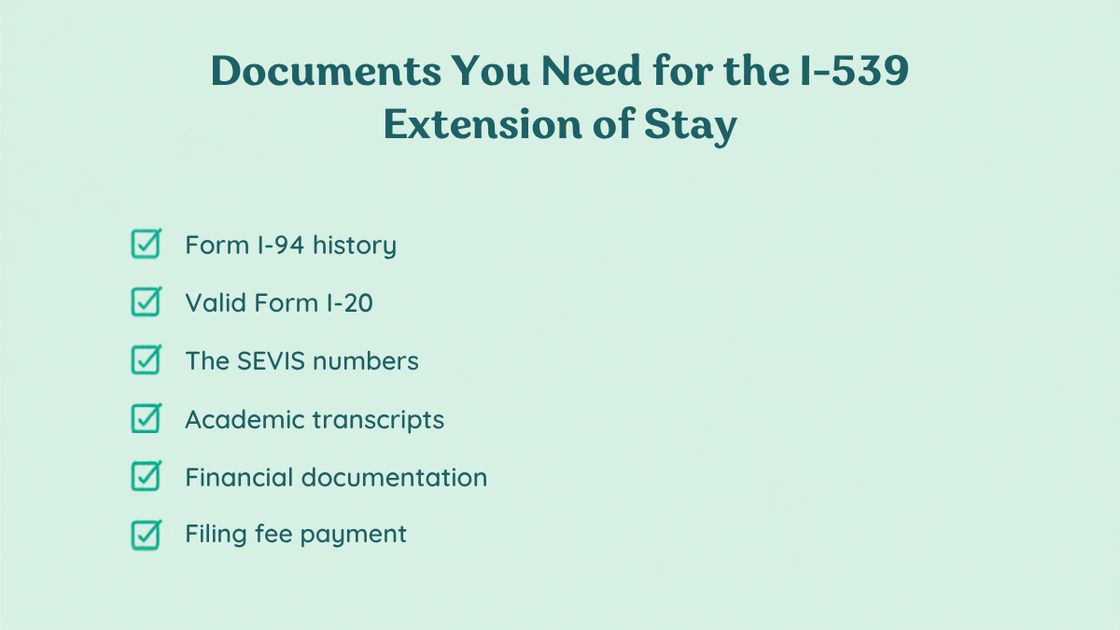
USCIS has published the checklist alongside the 09/15/26 edition instructions. The form asks F-1 applicants to demonstrate two things in particular. First, that they have continuously maintained lawful F-1 status. Second, that they can pay for their studies and living expenses without unauthorised work. The core documents required are the following.
- A copy of your current Form I-94 and copies of any previous I-94s covering your entire F-1 stay.
- A valid, properly endorsed Form I-20 issued by the school you are studying at or transferring to.
- All SEVIS numbers you have used across your F-1 history in the United States.
- Academic transcripts covering your entire F-1 stay — this is specifically how USCIS wants you to prove continuous maintenance of status.
- Financial documentation showing you can pay for your studies and support yourself and any dependents: bank statements, sponsor affidavits, scholarship confirmations, education loan disbursement letters.
- Payment of the current filing fee: USD 470 for paper filing or USD 420 for online filing. Because USCIS updates fees periodically, verify the current amount on its website before filing.
USCIS immigration attorneys have flagged that, in practice, officers will almost certainly ask for more evidence than this minimum once adjudications begin. For example, expect requests for programme progress letters from your DSO, updated financial documentation, and clear explanations for any breaks in academic history.
Premium processing and the USCIS new I-539 form
This is the single biggest open question for Indian students planning around the USCIS new I-539 form. Premium processing currently exists for I-539 applications only for a change of status to F, M or J status. USCIS confirmed this through expansion announcements in 2023 and 2025. However, it has not yet confirmed premium processing for I-539 extensions of stay filed by students already in F-1 status.
Status: unconfirmed. The current premium processing fee for eligible I-539 categories is USD 2,075, effective from March 2026. Still, immigration attorneys have noted a gap. USCIS has not updated its premium processing webpage to clarify whether the option will extend to F-1 extensions of stay filed under the new rule. Therefore, students planning to file an I-539 to extend F-1 status should assume standard processing until USCIS confirms otherwise.
Timeline and what to expect after filing the USCIS new I-539 form
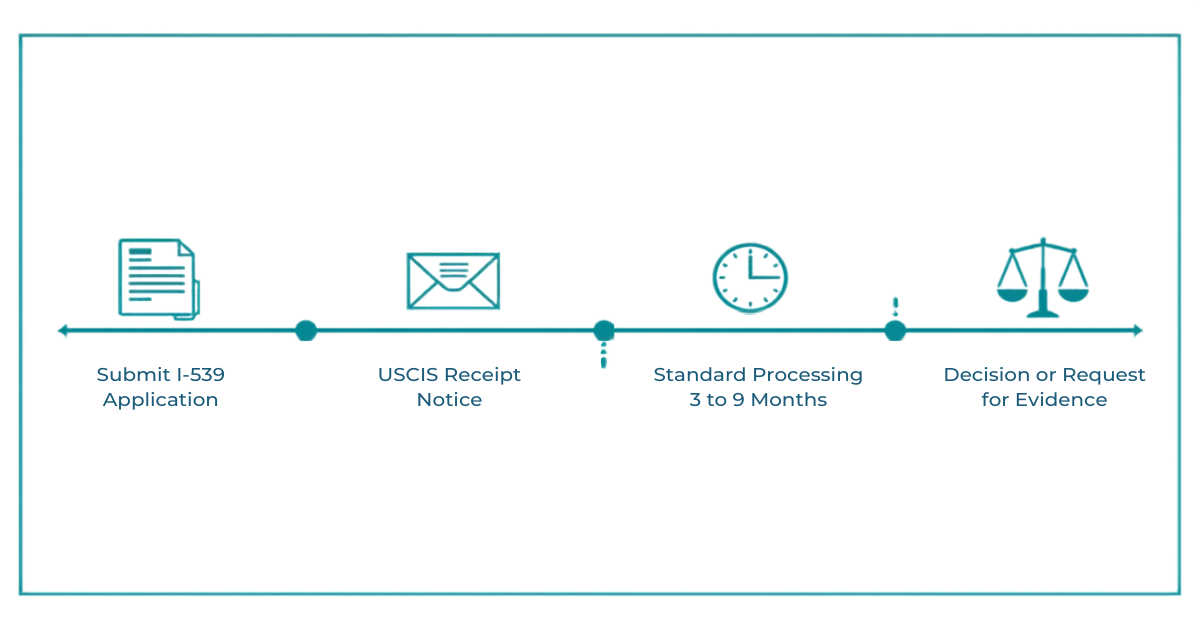
Here is what typically happens once you file.
- USCIS standard processing times for I-539 currently range from 3 to 9 months, depending on the service centre.
- If you file before your I-94 expires, you automatically get an extension of authorised stay for up to 240 days while the I-539 is pending, provided you filed the application on time.
- If USCIS denies your I-539 and your original I-94 has expired, you begin accruing unlawful presence — so filing early is the single most important protection.
- You cannot travel outside the US while your I-539 is pending. USCIS treats any departure as abandonment of the application.
Finally, USCIS may issue a Request for Evidence (RFE) if your financial or academic documentation is thin, so responding within the deadline is critical.
How Indian students should prepare for the USCIS new I-539 form
Here is how to get ahead of it.
- Save every I-94 record and transcript from day one of your F-1 status. You will need the entire academic paper trail.
- Track your I-20 programme end date closely. Any change of major, level or transfer should be reflected on a fresh I-20.
- Build a rolling financial file, because USCIS wants to see continuous ability to pay, not a one-time snapshot.
- Work with your DSO early. A programme extension recommendation on the I-20 is a prerequisite for the I-539 filing.
- If your programme is 5 years or longer, plan the I-539 filing well before your I-94 end date, ideally 6 months in advance.
USCIS new I-539 form: quick FAQs for Indian students
What is the USCIS new I-539 form?
Form I-539 is the standard USCIS application to extend or change nonimmigrant status. The 09/15/26 edition is the revised version released alongside the DHS Duration of Status final rule, which takes effect on 15 September 2026. It is the edition F-1 students must use to extend their stay from that date onwards.
Which edition of Form I-539 should I file?
It depends only on the date you postmark or submit your application. Before 15 September 2026, use the 08/28/24 edition. On or after 15 September 2026, use the 09/15/26 edition. USCIS rejects the wrong edition outright, so there is no crossover window.
Do all F-1 students need to file Form I-539?
No. The four year admission cap fully covers most standard four year undergraduate degrees. However, you need an I-539 in three cases: your programme runs longer than four years, you plan to stay past your Form I-20 programme end date, or you change programme or educational level and need extra time.
More questions about the USCIS new I-539 form
Is premium processing available for an F-1 extension of stay?
Not yet confirmed. Premium processing currently applies to I-539 filings for a change of status into F, M or J status. USCIS has not confirmed whether it will also cover extensions of stay for students already in F-1 status, so assume standard processing of 3 to 9 months until USCIS says otherwise.
Can I travel outside the US while my I-539 is pending?
No. USCIS treats any departure while your I-539 is pending as abandonment of the application, so plan any travel around your filing, not after it.
How much does the USCIS new I-539 form cost?
The filing fee is USD 470 for paper filing and USD 420 for online filing. Premium processing, where eligible, costs USD 2,075 as of March 2026. Because fees change periodically, confirm the current amount on the USCIS website before you file.
How Learner Aid supports F-1 students filing the USCIS new I-539 form
At Learner Aid, we are already updating our US student support. I-539 preparation is now a standard service for every F-1 student admitted from Fall 2026 onwards. Specifically, we help you track programme timelines against the DHS four year cap and coordinate I-20 extension recommendations with your DSO. We also build the financial and academic documentation file before it becomes urgent and, where needed, refer you to US-licensed immigration attorneys for the final filing review.
In addition, our education loan planning runs through associated partners, including Axis, Yes Bank, HDFC Credila, IDFC First, Avanse and Auxilo. It also accounts for the additional I-539 filing fees and any premium processing costs, if they become available.
Talk to a Learner Aid counsellor before your programme runs past year four.
The USCIS new I-539 form is not the paperwork you want to figure out at the last minute.